

Thanks to Alex Obadia and other members of the quantum punks community for providing comments and supporting ideas for this post.
What is Quantum Pseudo-Telepathy?
You may have heard of the concept of "entanglement" from science media, but not much about what it concretely means for engineers. Quantum pseudo-telepathy is the quintessential capability that entanglement lets you achieve. It can seem paradoxical, in that it appears to allow users to communicate instantaneously, potentially even at latencies faster than the speed-of-light barrier would allow. And in fact, this led Einstein to reject quantum mechanics as a complete description of physics.
But despite its seemingly paradoxical nature, pseudo-telepathy is ultimately quite simple to explain — so much so that I am somewhat surprised it's not discussed more explicitly in popular coverage of quantum computing. In this post, I’ll explain what pseudo-telepathy enables (completely avoiding the matrix algebra that more thorough descriptions usually use) and ponder a potential application.
The Non-Local Boxes
Imagine two boxes, connected by a wire. Each box has a left button and a right button, and two lights, one blue and one orange.
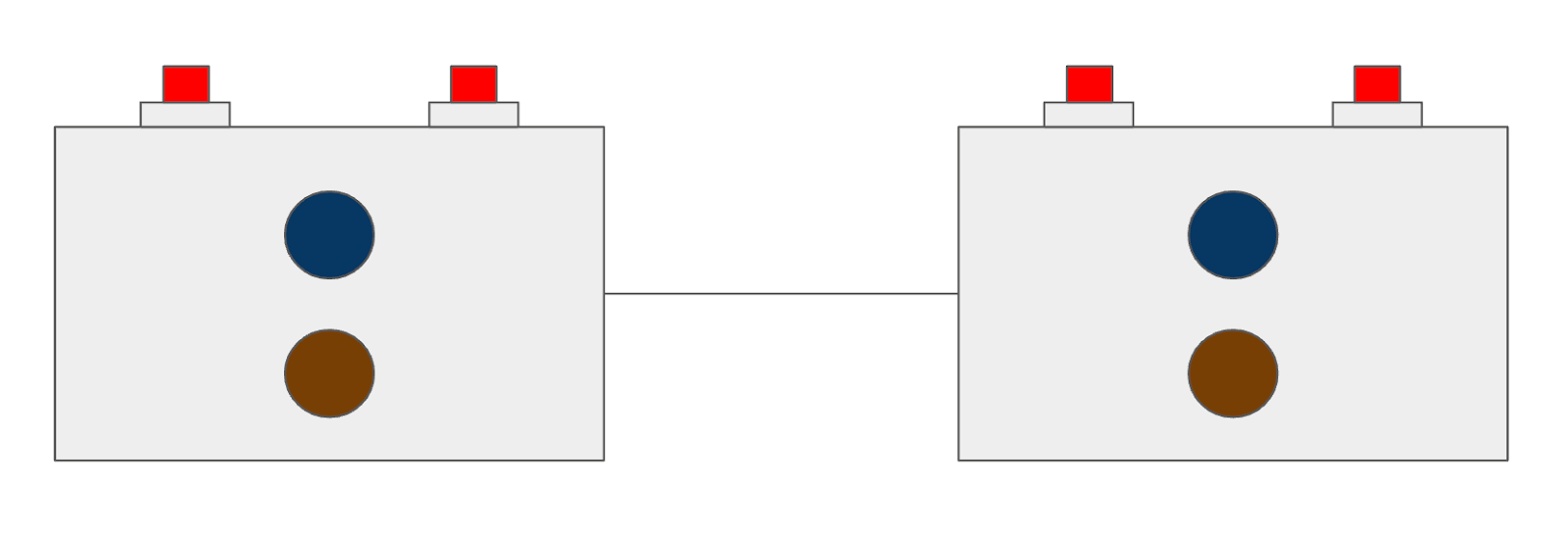
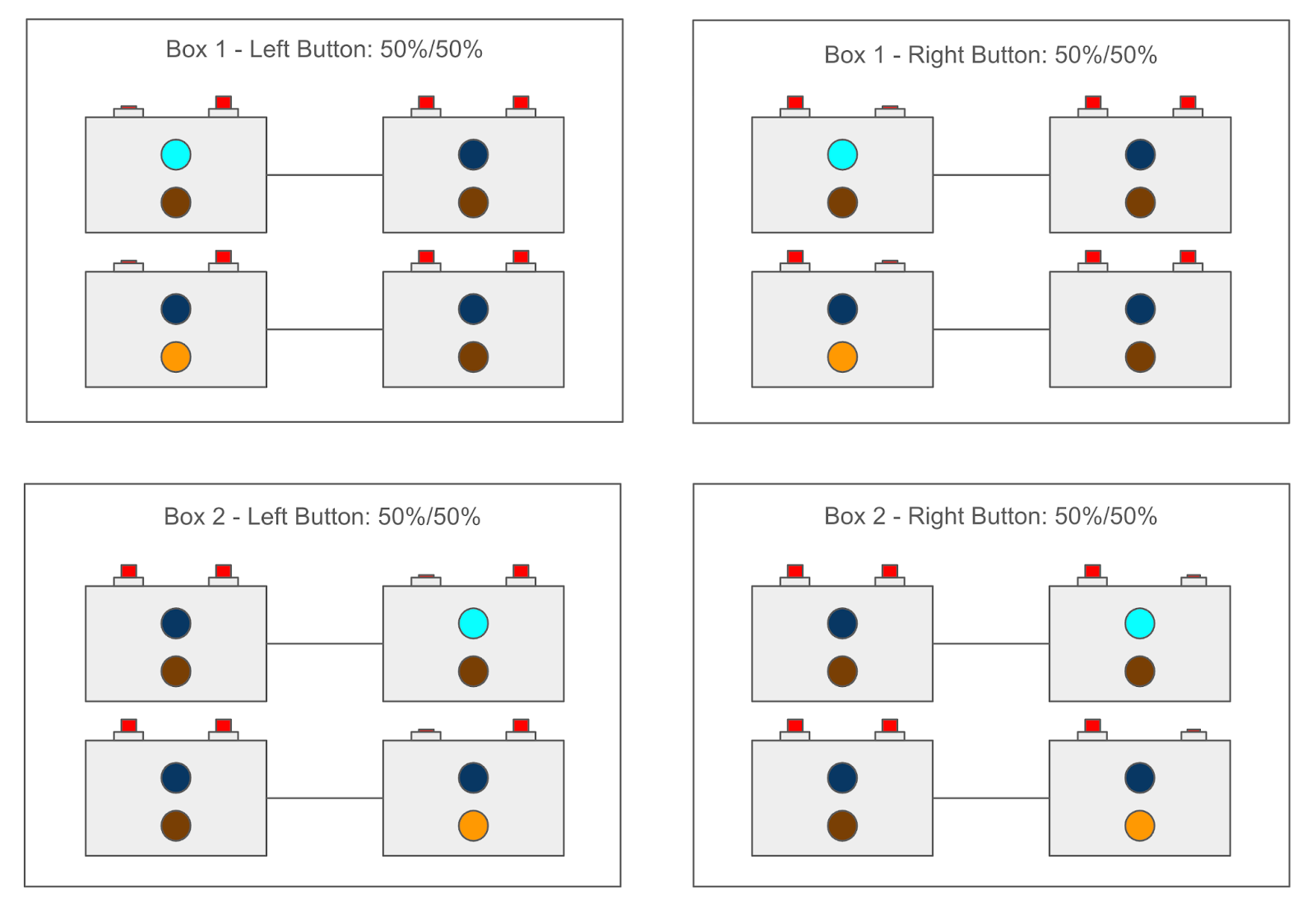
As a one-time use feature, when one of the buttons on one box is pressed, one of the two lights on that box will light up at random:
No matter which button you press, the blue and the orange light will each have a 50%/50% chance of turning on.
So far, this is not impressive, so we explain further: There is also an effect1 of one button-press/light-up result on the other. When buttons are pressed on both boxes:
If the left button is pressed on either box, the lights will be the same color.
If the right button is pressed on both boxes, the lights will be different colors.
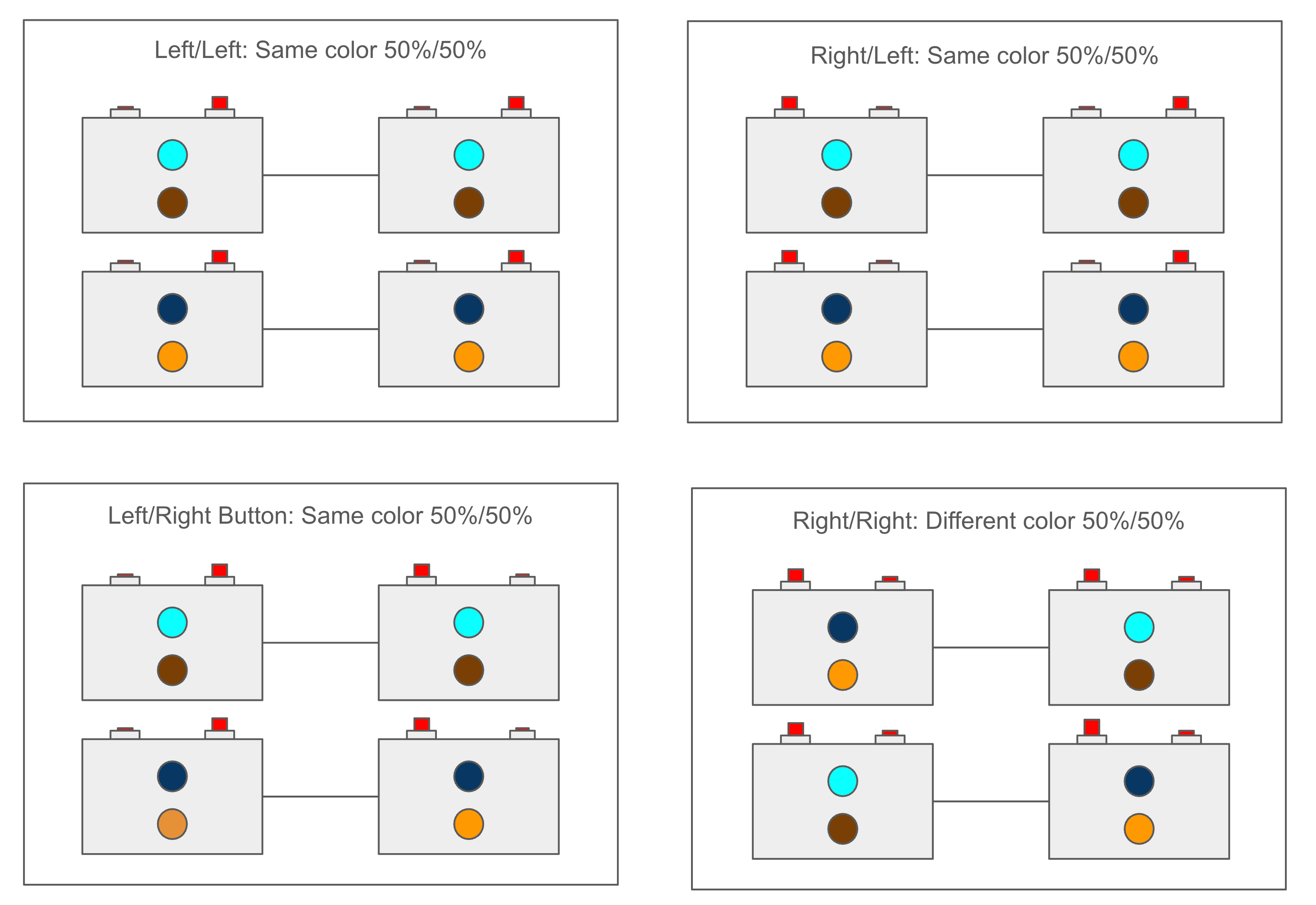
Note that as described, there is still no paradox here, and none of this changes the fact that each individual box is still 50%/50% to light up each color.
To further emphasize that nothing is surprising about this, one could imagine the box-pairs working this way: Whenever a button is first pressed on either box, a random color is chosen to light up on that box, and a signal is sent down the wire to the other box communicating which button was pressed and which color was chosen. Then, when someone presses a button on that other box, a computer in that box determines if both presses were 1s and thus whether the lights should be the same or different, and the correct light then lights up.
Imagine, though, that you could construct the box pairs without wires, or any other kind of communication. Could you manufacture the boxes so that even if they were brought extremely far apart, you would still get the same average behavior out of any combination of button presses?
This task is impossible
Seeing why takes a bit of thinking through possibilities, but ultimately isn’t too hard. Let’s get a sense of why this is by first making some failed attempts at a box-pair factory plan.
Clearly if we just build each box to randomly choose a color on any button press, there is only a 50% chance a particular box pair will behave correctly.
We could manufacture the boxes to always light up blue, and this would at least make the box outputs be the same when a left button was pressed. But this wouldn’t be correct when both right buttons were pressed, so there would only be a 75% success rate if the buttons were pushed randomly, and to boot, people would notice pretty quickly that the boxes were never turning orange.
We could manufacture one box to light up blue when the right button is pressed and orange otherwise, and the other box to light up orange when the right button is pressed and blue otherwise. This would work whenever a right button was pressed, but would result in different colors when the both left buttons are pressed. Again, there would only be a 75% success rate if the buttons were pushed randomly.
As it turns out, there is no way to build the boxes and get more than a 75% success rate when the buttons are pushed randomly. To show why, we can just go through every possible combination of lights for each button push2. All sixteen possibilities (two lights to choose from for each button to the power of four buttons) fail on at least one combination of button pushes.
The miracle of quantum technology is that we can actually build, in the real world, boxes that do better! While we can’t actually get 100%, we can succeed with probability 85% using entangled qubits.
Obligatory Mid-Post Q+A
How do we really know no communication is going on? Couldn't it be that there are just special particles that we can't isolate, but which are transmitting the same information that the wire would?
The point is that even if the boxes are light years apart and the buttons are pressed simultaneously, the lights behave the same. Relativistically speaking, there would be no possible way for any particle or other signal to move this fast to send this information. Experiments have been done to confirm that this works, even if the “boxes” are farther apart in light-milliseconds than could possibly allow for this kind of communication.
But wait, isn't what you're describing impossible? Couldn't you use this to send a message back in time and create a paradox?
While I have said this effect seems paradoxical, I haven't said it actually is paradoxical. The key is that from the perspective of someone with just one box, the result is always 50/50 random, it contains no information on its own. It's only when you later see the outputs from both boxes that you see the correlation. Thus, you can’t actually send information back in time with this.
What is this 85% number, where does it come from?
Technically it's cos²(π/8). If you like matrix algebra there is some math you can do to show why you can get this, and some slightly more complicated math you can do to show you can't do better. There are also a variety of different versions of all this with different numbers of boxes, different numbers of lights or buttons per box, different probabilities, &c. but these are beyond the scope of this post.
Applications in High Frequency Trading
And now for the fun/speculative part of the post.
Computer scientists have come up with a variety of examples of situations where using boxes lets you do better than you would otherwise be able to, without communication. But these "non-local games" tend to be very contrived. Can we come up with a practical application of pseudo-telepathy?
Such an application would have to:
Involve cooperating parties making decisions sufficiently simultaneously3, that the speed of light prevents their communication. If we aren't considering outer space, this means sub-second times between decisions.
Focus on providing enough value to offset the cost of setting up the equipment. Whoever we pitch our pseudo-telepathy device to, they should probably already be paying a lot for classical communication channels with extremely low latency.
These criteria suggest a very specific application: High Frequency Trading (HFT). This seems like a natural fit, since the firms that do this do try to send messages as fast as possible, and the highly abstract nature of their job makes it easy to think of examples of trading situations a quant4 might encounter which benefit from pseudo-telepathy.
A Scenario: The Merger

Consider the following scenario: We are a trading firm with offices in New York City and Chicago. We are looking forward to some press releases that two competing companies, one based in each city, will be making. Both companies are looking to hire new CEOs specializing in mergers. We have determined that if both companies successfully hire such a CEO, it is certain that the two companies will merge in the near future, and their stock prices will be highly correlated moving forward with an uncertain but overall positive outlook. On the other hand, if one of the companies fails to hire, then a merger won't happen, and one company will certainly soon go bankrupt and cede their market share to the other, in which case, the stock prices will be anti-correlated.
Our precise a priori expectations about the outcomes are as follows:
For each company we think that there's a 50% chance the hire happens.
If the companies merge, there is a 50% chance that both (converted) stocks triple over the next year, and a 50% chance they both third over that timeframe.
If the companies don’t merge, the company that fails will have their stock go to zero, while the other one doubles, with each company having a 50% chance to be the one to fail.
When our AI analyst reads the press reports (which will be released simultaneously in the two cities), it will know within microseconds whether each company will be hiring such a CEO. Each of our offices’ bots will then have to decide whether to spend half of the firm’s bankroll to buy a stock in the nearby company (by prior negotiation, we can’t spend less and can’t sell before the year is up). The bots will have only a few microseconds after they receive the news to do so, since we expect that other HFT firms will be looking to take advantage of the news - far too little time to communicate with the other office.
Since we are faithful adherents of the Kelly criterion, we are looking to maximize the expected logarithm of our wealth. I’ll leave the working as an exercise: What is our expected outcome from this game with the best strategy (and why is it analogous to the problem of getting a higher score in the box game)?
Open Questions and Further Reading
There are some things I’m still not satisfied I have good answers to:
The point about only being able to spend all-or-none feels at odds with the Kelly criterion. Is it possible to formulate asset value projections where this requirement isn’t necessary? In particular, does the tendency towards convexity of preferences pose a barrier here?
Are there other financial or non-financial scenarios that do well as an example here?
If we take more reasonable theoretical models of HFT microstructure environments, and expand our view from the boxes described above to the full space of what is achievable through quantum entanglement, what are the strategies that dominate?
And some more papers you can read to go deeper:
Coordinating Decisions via Quantum Telepathy: A paper on entanglement for HFT
Quantum Bidding in Bridge: A fun paper if you are familiar with contract bridge.
“Effect” is itself a tricky term here, because it implies a cause-and-effect relationship, and whether such a relationship exists is philosophically sticky. I encourage you to forget about the meaning of this word and focus on the probabilities of the outcomes I am telling you about.
You could also consider constructions that make random choices, but you don’t have to: If there were a strategy for constructing box pairs where boxes made random decisions after a button was pressed, we could cut down our final product complexity by making those random decisions on what to do for that button press before the box left the factory, and baking the result into the hardware to the box.
Either a "Spacelike interval" in the parlance of special relativity, or perhaps locations that are technically close but hard to communicate between with straight-line signals (e.g. opposite sides of earth).
Pun intended